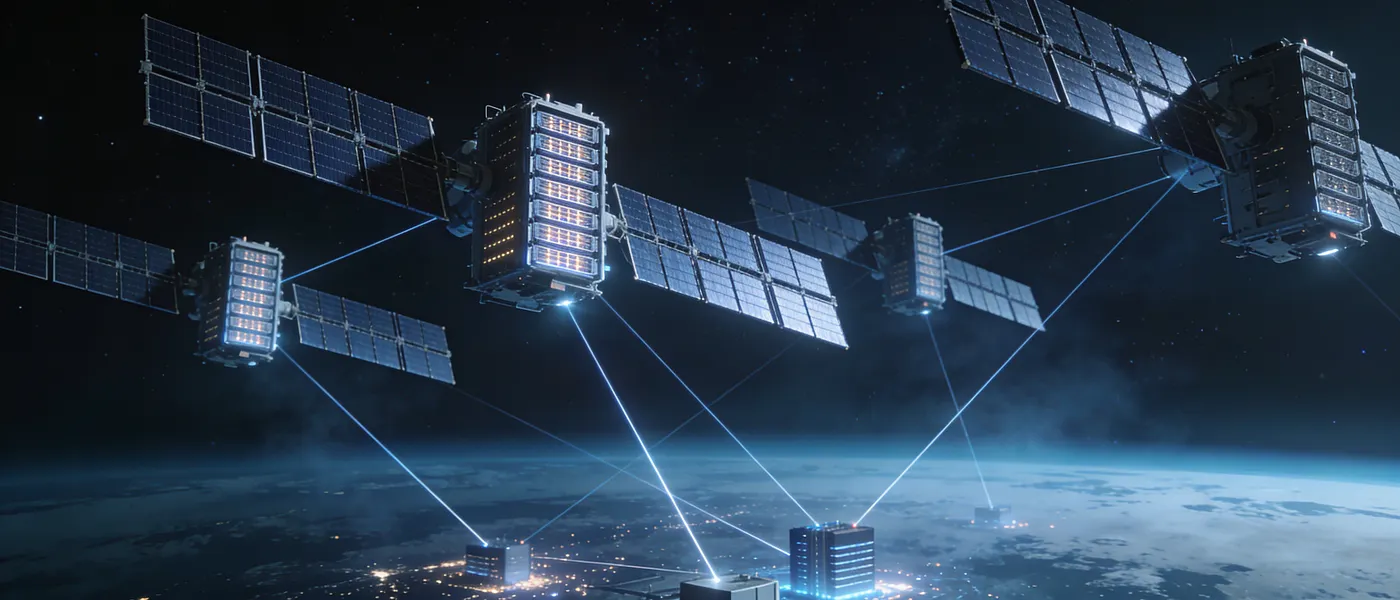
Data centres in space sound like science fiction, but over the last 18 months the narrative has shifted into reality. Google talks about space-based AI infrastructure. Elon Musk talks publicly about orbital data centres as the natural endpoint of the AI and energy story. At Maargin, we are aiming to build India's LEO satellite constellation network and put orbital data centres in space.
The narrative is indeed seductive. In space there is abundant sunlight, no land constraints, and no local communities that will push back against another hyperscale facility. At a time when terrestrial data centres are colliding with grid bottlenecks and potable water stress, orbital data centres look like the panacea. Yet as soon as you start treating "space DC" as a real design brief rather than a slide-deck meme, the constraints compound. What you gain in energy, you lose in heat rejection, maintainability and bandwidth. What looks frictionless from a planetary infographic turns into a stack of hard problems — from chip physics all the way up to global governance.
1. Thermodynamics, the unforgiving constraint
On Earth, you can blast air down a hot aisle, run chilled water through cold plates, dump waste heat into the atmosphere or a river. In orbit, there is no air and no water. You cannot rely on convection. Every watt of heat generated by GPUs and TPUs must travel through conduction paths into radiators, then leave the system as infrared radiation. That simple fact changes everything.
If you design an orbital DC as a high-density rack, you quickly discover that the bottleneck is the radiating surface. To sustain the 30 to 100 kilowatts per rack that next-generation AI clusters demand, you need radiator surfaces with significant area, oriented carefully away from the Sun and shielded from reflected light. Each extra accelerator is both more compute and more heat you must get rid of in a vacuum. Engineers talk about variable-emittance radiators, micro-channel liquid cooling circuits and phase-change materials that store heat during peak periods and bleed it out over an orbit. These are impressive pieces of engineering — but unproven at the multi-megawatt, multi-year scale that real infrastructure requires.
2. Energy is not free at the accelerator
Space advocates often say "8× more solar energy" and stop there. It is true that above the atmosphere solar panels receive more consistent and intense irradiation, and a sun-synchronous orbit can give you long stretches of near-continuous sunlight. The problem is translating photons into a stable power envelope for dense compute. Solar panels have specific power and specific mass limits. If your payload wants megawatts of continuous power, panel area and mass grow quickly. At some point the array dominates the system and starts to look like a fragile, complex power plant with a DC attached — rather than the other way around.
On Earth, if your DC has a bad year of solar generation, the grid bails you out. In orbit, there is no grid. You are your own generator, transmission network and battery system. Any significant mismatch between generation and demand has to be solved by load shedding, overbuilding or storage. It is not enough that the energy is "clean" and "free" at the point of use. It has to arrive at the accelerators with the right voltage, at the right time, for years, under radiation and thermal cycling and occasional eclipses.
Process it in orbit, extract the features, discard the rest — transmit insights, not pixels.
3. Reliability in a hostile environment
Modern AI accelerators are designed for climate-controlled buildings with well-behaved power, modest temperature swings and a manageable radiation background. Low Earth orbit offers none of these. Charged particles flip bits and accumulate damage in semiconductor structures. Solar storms can create bursts of errors or knock out unprotected electronics outright. You can shield, but shielding adds mass. You can use radiation-hardened components, but those lag far behind the commercial devices the AI industry actually wants. You can add redundancy, error correction and checkpointing in software — but each of those chips away at usable performance and increases complexity.
Reliability does not stop at the chip. Optical terminals for inter-satellite links need micrometre-scale pointing stability despite vibration and mechanical stress. If a pump in a ground DC fails, a human replaces it. If a pump in orbit fails, you are looking at robotic servicing missions, human missions, or accepting the loss of that module.
4. Networking and data gravity
The rhetoric often goes: move compute to where the energy is. The harder question is whether you can also move data to where the energy is without paying an unbearable price in bandwidth and latency. For space-native workloads the answer is clearer — if your satellites generate petabytes of Earth-observation imagery, processing it in orbit to extract features and discarding the rest makes sense. For workloads originating on Earth, it gets messier.
For an orbital DC to feel like a genuine region of the cloud, it needs two things. First, extremely high-bandwidth, low-loss inter-satellite links so the cluster behaves like a fabric rather than a swarm of isolated nodes — almost certainly free-space optical meshes, with tight formation flight and precise pointing. Second, robust high-capacity links to ground. Optical ground stations provide high bandwidth when the weather cooperates, but fog, rain and turbulence degrade performance; radio has broader availability but limited spectrum and lower peak rates. For interactive services, the combination of round-trip delay and intermittent visibility sets a hard floor on user experience.
5. Economics and governance
Terrestrial data centres are heavy on local externalities but familiar in structure. We know how to cost them, regulate them and protest against them. Orbital DCs move many of those externalities out of sight, but they do not make them disappear. Launching thousands of tonnes of hardware has a climate and atmospheric impact. Filling popular orbital shells with large structures complicates debris risk for everyone else. If a satellite breaks up, it is not just your capex that is lost — it is long-term access to that region of space for other missions.
Launch costs have fallen dramatically, but they are still not negligible, and the capital intensity of an orbital region remains far higher than building another hyperscale facility near a cheap grid connection. Proponents argue that, once built, an orbital DC can enjoy effectively free, carbon-neutral energy for a decade. Skeptics point to uncertain lifetimes, servicing costs, and the risk that chip cycles on Earth will outpace the upgrade cadence in orbit — by the time you finish qualifying and launching a generation of accelerators, the market may already have moved on.
Then there are questions of law and geopolitics. Whose jurisdiction applies to data processed in orbit? How do export controls, privacy regimes and data-localisation laws interpret a model that ingests European data, trains in an American-owned cluster over the Indian Ocean, and serves users in Africa? Who is liable if a failure triggers a debris cascade? None of these questions is unsolvable, but none is trivial.
All of this can sound like an argument against the entire concept. It is not. It is an argument against treating "data centres in space" as a clean, green, inevitable next step. The more interesting framing is to see orbital compute as a niche but important tool in a broader portfolio of infrastructure. It makes sense where energy is clearly the binding constraint and where workloads are highly parallel, energy-intensive and reasonably tolerant of latency. It makes less sense as a default home for generic web workloads or ultra-interactive services.
There is also a deeper reason to take the idea seriously. Whether or not we end up with hyperscale clusters in LEO, the exercise of designing them forces us to re-confront the physical limits of compute. On Earth, cheap land, abundant cooling water and an elastic grid have allowed the industry to externalise many constraints. In orbit, every joule, every kilogram and every bit has to be justified. For people interested in frugal AI and resource-efficient computing, space is not just a new location for the cloud — it is the ultimate stress test for our assumptions.